The Horse in Luxury: Between Lunar Symbolism and Enduring Presence
WATCHES & JEWELLERY
Noora Pharaon
4/30/202612 min read
This year, the Chinese New Year marked the transition into the Year of the Horse. Across the luxury industry, this celebration took shape through capsule collections, limited editions, and emblematic details such as the use of red and gold. At the center of these expressions, the horse emerged as a prominent motif — yet it is far from a recent addition to luxury. It has long been embedded in its visual and cultural language.
Historically, the horse has held strong symbolic value across cultures, often associated with power, movement, loyalty, and prestige. In Ancient China, it was one of the most recurrent animals, reflecting both its central role in society and its enduring meaning. This significance extends across both Eastern and Western traditions, where the horse holds a distinctive place that continues to influence luxury today. The horse appears as a recurring figure, shaped by cultural heritage, brand identity, and creative direction. Its role extends beyond symbolism alone. In the context of the Chinese New Year, its reappearance reflects not only an aesthetic choice, but also a form of cultural alignment and market positioning, particularly within the Chinese luxury market. The horse thus represents a symbolic universality reflected in its presence within the global luxury industry. This raises a broader question: how does the horse persist, evolve, and reappear within the luxury watchmaking and jewelry industries?
The Horse: A Recurring Motif
The Chinese New Year brings the horse to the forefront — onto the stage, so to speak — but this visibility only amplifies a presence that was already firmly established in the watchmaking and jewelry industries. Far from isolated references, the horse has long been woven into the visual language of luxury houses, tied to heritage and identity. In watchmaking and jewelry in particular, these creations reflect a broader strategy of cultural alignment and market positioning, especially within the Chinese luxury market. At the same time, for certain houses such as Hermès, the horse is not a seasonal reference but a longstanding emblem at the core of brand identity. In other cases, brands introduce horse-inspired designs more freely, using the motif as a source of creative expression rather than a fixed code. Across these different approaches, the horse continues to evoke associations of power, prestige, and an elevated lifestyle, reinforcing its relevance across both the creative and commercial dimensions of luxury.
The Horse of Hermès
The horse is not simply a motif at Hermès — it is the very foundation of the Maison. Hermès was established in Paris as a harness atelier in 1837 by Thierry Hermès, a French harness artisan. From the beginning, the house devoted itself to the craft of equestrian harnessing, producing pieces renowned for both their elegance and their durability. This excellence was recognized as early as 1867, when the Maison was awarded at the Universal Exposition of Arts and Industry in Paris. In a very real sense, the horse was the first wearer of Hermès. Today, the house has broadened its catalogue considerably, yet the horse remains at the beating heart of its creative identity. Equestrian lines are still offered, but the presence of the horse extends far beyond them — running through the collections as a thread that connects the Maison's origins to its contemporary expression.
In Jewelry
Within the jewelry categories, equestrian traces appear across both the gold and silver collections. The iconic Clic H bracelet, celebrated for its versatility, includes a model called Chevaux en Liberté. An entire collection is dedicated to the equestrian world under the name L'Équestre, with pieces that draw on references such as the Point de Sellier — a stitching technique used in harness-making — and Galop — the fastest pace a horse can reach. These are not merely decorative names but details that carry a story.
In Watches
The equestrian world is equally present in the watchmaking of Hermès. One of the house's principal watch lines bears the name Galop d'Hermès, a direct reference to the movement of the horse. Among its exceptional timepieces, the Arceau Samarcande stands out: its dial takes the form of a horse's profile, through which the movement of the watch becomes visible. The mechanism appears almost framed within the outline of the animal — a meeting point between horological craft and the founding emblem of the house. It is, in many ways, a piece that holds together where Hermès began and where it has since expanded.
Yet it is in the Métiers d'Art collections that the horse finds perhaps its most intimate and recurring presence. Across these watches, the horse appears as a companion to the dial through a story, a glance, a silhouette. The Slim d'Hermès Joma Kurabe is one such example. The Slim d'Hermès is a line celebrated for the refined simplicity of its design. For this piece, Hermès collaborated with Buzan Fukushima, a Japanese artist known for his paintings on ceramics. Working on an entirely new surface, the result depicts a horse race held in Kyoto, bringing together two distinct worlds of craft.
The Arceau Rocabar de Rire takes a different tone entirely. This watch is playful, capturing the free spirit of the animal. What makes it particularly remarkable is a detail that speaks directly to the Maison's origins: the dial background is made of horsehair.
Other Métiers d'Art pieces continue this dialogue between the horse and the watchmaker's craft: the Arceau Harnais Français Remix, the Slim d'Hermès Minuit au Faubourg, the Arceau Cheval Cosmique, and the Arceau Mon Premier Galop, among others — each a reminder that at Hermès, the horse is never far from the dial. For Hermès, the horse is both the origin and inspiration: where the Maison started, and what continues to guide its creative vision.
The Horse for the Chinese New Year: Watches
For the Chinese New Year, some houses choose to mark the occasion with dedicated releases. The motivations behind these creations are often multiple — a response to the growing demand within the Chinese luxury market, a celebration of the zodiac cycle, and an opportunity for creative expression. Whatever drives them, the resulting pieces are frequently among the most remarkable of the year. Such releases were unveiled by houses including Piaget, Harry Winston, Vacheron Constantin and Jaeger-LeCoultre.
Piaget
Piaget seems to have developed a tradition of interpreting the Chinese zodiac through its iconic Altiplano line, channeling its ultra-thin mastery and distinctive elegance into the Métiers d'Art. This year, the house released the Altiplano Zodiac High Jewellery Watch — a creation that unites horological and high jewelry craftsmanship in a single piece. The dial is where the horse resides, surrounded by gems, depicted in a cabré position: rearing up on its hind legs, a posture that has long symbolized power and controlled force. The stones arranged around the figure amplify the sense of movement while evoking an almost lunar atmosphere — a sky scattered with light. The piece is a limited edition of 18 timepieces. This is not the first time Piaget has turned to the horse for the Chinese New Year. In 2014, the house released a limited-edition Altiplano to mark the Year of the Horse, as part of a Métiers d'Art collection titled Mythical Journey by Piaget, inspired by the ancient Silk and Spice Routes. The horse depicted on this dial is a Ferghana horse — a breed once desired by Chinese emperors and considered one of China's earliest prized imports. Its portrayal, rendered in dark, commanding tones, conveys something of that history: a horse associated with conquest, desire, and imperial prestige. Across both pieces, Piaget demonstrates not only a desire to engage with the Chinese New Year, but a genuine understanding of what the horse carries — its history, its power, its symbolism.
Harry Winston
Harry Winston is another house that has made the Chinese New Year zodiac watch a recurring tradition. For the Year of the Horse, the house released the Harry Winston Chinese New Year Automatic 36mm, a limited edition that is distinctive in its creative choices. What sets this piece apart is its colorway. Where other houses may approach the occasion with subtlety, Harry Winston leans fully into the traditional colors of the Chinese New Year — red and gold — making the cultural alignment unmistakable. The horse itself is depicted in a cabré position, rendered as a figure of fire, which the house describes as an expression of the zodiac animal's spirit: independence, power, and adventure. The flames do not simply add drama but rather reinforce what the horse symbolizes. Diamonds are set throughout the piece as a signature of the house and as a natural meeting point between Harry Winston's identity and the occasion it is celebrating. What makes this watch particularly interesting is that unlike pieces where the horse is simply introduced as a motif, here the entire creative expression is dedicated to the celebration. The color, the posture, the fire — every detail points to the celebration. It is a watch that does not merely include the occasion but is built around it.
Vacheron Constantin
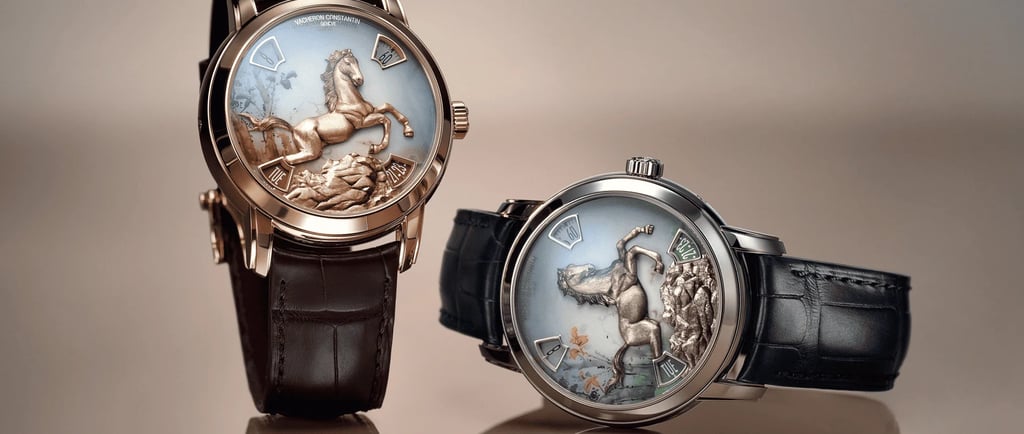
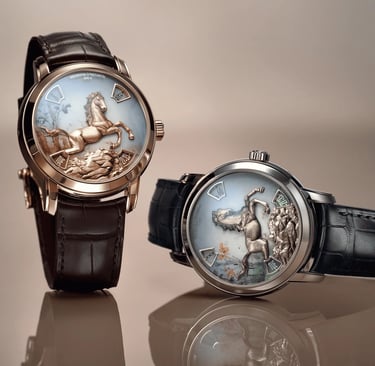
Vacheron Constantin has its own tradition of marking the Chinese New Year through its Métiers d'Art craftsmanship. This collection is called The Legend of the Chinese Zodiac. This year's release, The Legend of the Chinese Zodiac — Year of the Horse, continues that lineage, reflecting the house's dedication to the Chinese New Year as a celebration that deserves its own creative chapter. What is striking about this piece is the horse itself, which lends itself to two readings: it can be perceived as cabré, or equally as en galop. The ambiguity is not a weakness — it adds to the sense of energy and freedom that the posture conveys. Vacheron Constantin describes the horse as a symbol of vitality and freedom, and the dial as a whole seems designed to carry that feeling. What distinguishes this watch from other watches is the background. The dial features wild flora rendered in an ink painting style — a technique rooted in Chinese artistic tradition. The flowers and the horse speak to the same idea: a sense of vitality, freedom, and a spirit that cannot be contained. The piece is offered in two versions: one in a gold tone, one in blue. A refined detail sets them apart — the flowers in the background take on the opposing tone of each watch. The blue version carries golden flowers, while the gold version is grounded by blue flowers. It is a quiet but considered detail that rewards a closer look. This is not the horse's first appearance in The Legend of the Chinese Zodiac. In 2014, Vacheron Constantin released two watches for the Year of the Horse with a similar two-tone approach. The horse in those pieces, however, carries a different energy — its posture suggests presence and groundedness rather than movement. The background, too, differs: in place of wild flora, a leaf motif appears, one that resonates with Chinese iconographic tradition. In both pieces, the watchmaking expertise of Vacheron Constantin meets the richness of Chinese artistic heritage, giving the celebration a deeper cultural resonance.
Jaeger-LeCoultre
Jaeger-LeCoultre is a house that has long embraced artistic collaboration, and the iconic Reverso collection is perhaps its most genuine expression of this. With its reversible case, the Reverso has always offered what the house itself describes as a truly inspiring artistic canvas — and for the Year of the Horse, that canvas was entrusted to the legacy of Chinese artist Xu Beihong. What is immediately striking about Jaeger-LeCoultre's approach is its discretion. The three watches released for this occasion — the Reverso Tribute Enamel Xu Beihong Running Horse, the Reverso Tribute Enamel Xu Beihong Standing Horse, and the Reverso Tribute Enamel Xu Beihong Two Horses — make no explicit mention of the Chinese New Year in their names. It is only through their description that one understands the intention: a tribute to the Year of the Horse, paid through the work of one of China's most celebrated painters. This distinction matters. Xu Beihong is best known for his ink-wash paintings of horses — works that were not created for any celebration, but that exist in their own right. By reproducing them on the dial of the Reverso, Jaeger-LeCoultre is not designing a horse for the occasion. It is honoring an art that was already there. There is something both humble and deeply respectful in that choice. The three watches give form to four horses, each carrying its own presence. The running horse conveys freedom and endless energy — what the house describes as the essence of untamed energy and resilience. The standing horse communicates something different: stillness, power, and an almost commanding presence. The house evokes the noble steed, a symbol of power, grace, and strength. The third watch brings together two horses and it is perhaps the most intriguing of the three. It is the first time a pair appears — one black, one white — and there is something compelling in that union. Two powerful animals evoking a sense of harmony and balance that a single horse alone could not carry. Three watches. Four horses. One artist. And a celebration honored not through the creation of something new, but through the recognition of something that already existed.
The Horse for the Chinese New Year: Jewelry
The celebration of the horse for the Chinese New Year is not exclusive to the grandes maisons or the world of watchmaking. It is also found in the work of smaller, independent creators — artists who bring their own perspective, their own craftsmanship, and their own voice to the subject, while honoring both the power of the horse and the significance of this celebration.
Castro Smith
Castro Smith is a goldsmith and traditional hand engraver based in the United Kingdom, whose work draws inspiration from history, mythology, and the natural world. Trained in painting and printmaking, and with additional training in Japan, his style is entirely his own — intricate, deeply detailed, and immediately recognizable. There is a captivating quality to his engravings: the closer you look, the more you find. For the Year of the Horse, Castro Smith released the Fire Horse Ring, entirely hand-engraved, offered in two colorways. The horse is depicted mid-gallop, surrounded by flames, with diamonds set into the fire to give the piece its depth. But what makes this ring truly remarkable is a detail that goes beyond what the eye first sees: the flames do not stop at the surface. They continue inside the ring, engraved where most would leave the metal bare. It is a detail that will go unnoticed by many — and that is precisely the point. It speaks to a craftsman who engraves not for display alone, but out of a genuine commitment to the work itself. The horse in this piece is powerful and muscular, caught in full movement. The energy of the animal radiates from every detail, carried entirely by the precision of the engraver's hand.
Annoushka
Annoushka is a London-based jewelry house founded by Annoushka Ducas, whose life has revolved around jewelry for many decades. At the heart of her creative philosophy is a belief that jewelry is not merely decorative — it holds memory, emotion, and personal meaning. This vision is perhaps best expressed through her charm collections, which she has even dedicated a podcast to, titled Life in Charms. Among her equestrian pieces, the riding helmet charm is a particularly thoughtful creation — handcrafted in gold and adorned with black diamonds. It is a small but precise rendering of an object deeply tied to the equestrian world, and it speaks to something the other pieces in this article do not: the horse not as a symbol, but as a way of life. For many, the equestrian world is not a reference or a motif — it is part of who they are. For the Chinese New Year, Annoushka released the Carved Crystal Horse Charm, created in celebration of the Lunar Year of the Fire Horse, which the house describes as a symbol of strength, courage, and freedom. What sets this piece apart from others explored here is its tone. Where many houses lean into movement and force, this charm is quiet. The horse is depicted in the side profile, and there is a stillness to it — a sense of presence and calm that feels distinct. The piece is handset with Essex crystal, a material with roots in British craft tradition, adding a personal touch that connects the piece to the house's own origins. A final detail: on the reverse of the charm, a raised horseshoe is hidden from view — a small gesture of luck for the wearer, and a reminder that in Annoushka's work, it is often what is not immediately seen that carries the most meaning. What defines Annoushka across both pieces is the ability to create works that are small in scale but generous in detail — playful, precise, and full of intention.
Cece Jewellery
Cece Jewellery is a fine jewelry house based in the United Kingdom, founded by an artist who works with enamel on miniature surfaces, drawing her motifs by hand. Her inspiration comes from nature and imagination, and there is a quality to her work that feels almost folkloric — each piece carries a story, told entirely through the artistry itself. Her Chinese Zodiac Ring is described as a celestial talisman guided by the stars of the Chinese Zodiac. The horse is depicted in motion, surrounded by flowers, and there is a lightness to the piece that sets it apart from others explored here — it does not reach for power or force, but evokes something more delicate, almost weightless. For the Year of the Horse, she also released a broader dedicated selection, describing her pieces as talismans that channel the horse's love of freedom, warmth, and fierce independence. Among them, The Traveller's Tale Ring stands apart. Inspired by the Irish ballad A Raggle Taggle Gypsy, it depicts the horse in a cabré position — not to suggest power or confrontation, but the thrill of adventure and the pull of freedom. The flowers hand-enameled around the horse, rendered with remarkable precision on such a small surface, carry that same spirit. What makes this piece particularly significant is that it is the first in this article where the horse is rooted in a completely different cultural tradition — and yet it carries the same qualities. This is perhaps what Cece Jewellery reminds us most clearly: the horse does not belong to any single story. It finds its way into all of them.
The Horse: Always Present
The horse has always been present in the world of luxury. For some houses, it is a founding emblem, inseparable from their identity. For others, it surfaces through creative direction, through heritage, through a detail that carries more meaning than it first appears. And for independent artists, it becomes a subject of its own — approached with the same care, the same depth, and the same conviction. What the Chinese New Year does is bring the horse to the forefront. It does not introduce it — but it gives it a stage. And it is often thanks to this celebration that some of the most beautiful portrayals of the horse come to life: pieces conceived with care, with cultural depth, and with a genuine desire to honor what this animal represents. Across cultures, across traditions, across centuries, the horse remains a remarkable animal — powerful and free, grounded and untamed. The luxury world has always known this, and the Chinese New Year simply reminds us.