
Sculpting the body: a retrospective of Pieter Mulier at ALAÏA
FASHION
Alexia Delcaire
5/16/20267 min read
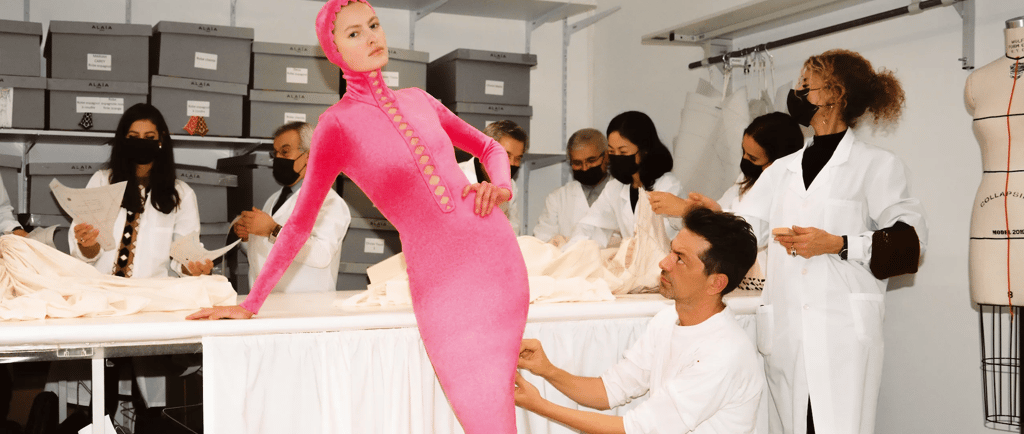
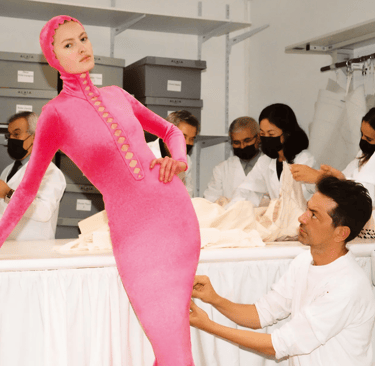
Paris, France, February 5th, 2021.
Pieter Mulier is appointed as Creative Director at ALAÏA, the first of the house, after the passing of its founder Azzedine Alaïa. Fast forward five years.
Milan, Italy, February 5th, 2026.
VERSACE appoints Pieter Mulier as Chief Creative Officer.
Those five years were as defining for the maison as they were for the designer who directed it. In remarkably little time, what we witnessed was a masterclass in what revival truly means. Together, ALAÏA and Mulier experienced a new dawn without ever forgetting their roots.
A MAN IN THE SHADOW
Despite his popularity in the industry, the quiet Belgian designer had struggled to climb the ladder. Known as Raf Simons’s right-hand man, he worked in his shadows between 2001 and 2018 in major maisons including Jil Sander, Christian Dior, and Calvin Klein. Although he was recognized by his peers, Mulier was absent from the spotlight. This difficulty to grow within the industry weighed heavy on him, naturally. He indeed confessed: “I thought I wouldn’t do fashion anymore. After New York, I thought fashion was finished for me. I didn’t want to do it anymore: sneakers, sportswear, all of it” (referring to his former job at Calvin Klein). Mulier took a break from fashion for a while. Despite talks with a few houses, it was never the right fit.
And then ALAÏA happened.
A house that carved its own timeline, indifferent to the ever changing trends and external noise – the perfect fit.
In particular, Pieter Mulier’s devotion to exacting craftsmanship echoed that of the founder, known as the Master of Couture, who spent the vast majority of his time in his atelier, uninterested in fame. His work spoke for itself.
A focus on the creative process over celebrity,
An obsession with rigorous tailoring,
A pressure for perfection in every detail.
These shared values made Mulier a natural successor. Both were discreet men whose talent whispered through the quality of their artistry. Their recognition came not from self-promotion, but from the intrinsic greatness of their creations.
Ushering in a new era for the house, Mulier expressed a sincere dedication to shedding light upon its archives. Alaïa had been saving his work since the 80s. After his passing, his ateliers created seasonal collections based on samples, products and ideas from these archives. Only a few designers have created a strong enough foundation for a brand to pull this off. Nevertheless, to achieve long-term commercial growth, the brand needed creative momentum. But unlike most maisons who actively promoted their storylines and displayed their fashion on social media platforms, ALAÏA’s revival had to be in line with its founder’s understated identity. Mulier’s aim was to show the younger generation why this was a historic maison and how it remained modern and relevant.
His first collection, Spring/Summer 22, brought ALAÏA to the streets. The debut felt like a reset, setting straight what ALAÏA was. Mulier did not invent new silhouettes, he started his tenure by outlining the key elements of the ALAÏA wardrobe. The first pages of this new chapter constituted a dictionary of what “ALAÏA” meant.
“It’s for my generation… to explain to the younger generation what ALAÏA is”, he revealed to British Vogue.
AN ARCHITECTURAL APPROACH TO DRESSMAKING
Arguably, the defining aspect of an ALAÏA design is its construction. Azzedine Alaïa, who had initially studied sculpture, called himself a “bâtisseur”, a builder of simple-looking clothes that were in fact incredibly complex in construction. Pieter Mulier is also a “bâtisseur” of his kind: he studied architecture before pursuing his professional journey in fashion design. This training actively structured his perspective on volumes, lines, and space, central elements in his approach to dress.
Notably, his sophomore collection was shaped by this architectural vision. As Mulier described it: “There’s no concept, only sculpture, […] how can you change the body with fabric?”
The maison’s dedication to craft is imbedded in the modeling of the body. Azzedine didn’t draw, he draped the fabric on the mannequins. For Pieter, this is the ultimate way to design “because the more you just construct without it, the less you feel the body.”
One striking example of this process of modelling and remodeling of fabric is the series of Spanish Dresses that were recreated as bell-bottoms. The construction of the skirts, and even their yarns – used in 1982 and 1988 – remained untouched, simply remodeled as pants.
IN MOTION
ALAÏA is a maison deeply anchored in movement. The bodies are corseted to follow the contours, not to cage them. ALAÏA is about empowering the real, active woman, always on the go. Clothes become a liberating armor, a shield for women to reveal their true selves.
With cues from a 1984 collection, Mulier explored the pragmatic ethos of the house in his eighth show, in which the body is perceived as a kinetic sculpture. Garments are meant to act as a second skin, shaping and giving strength to the wearer.
Furthermore, he pushes this “new femininity” initiated by his avant-garde predecessor, based on embracing the sensuality of the female body. In his third collection for the house, a deep-rooted eroticism throbbed through the pieces. The designer touched upon the sexually-charged garments with which Alaïa, in the words of his ardent fan Tina Turner, “gave women back their bodies”.
This attachment to movement is strongly connected to the fact that Alaïa had been appointed as early as 1979 as costumier of the Crazy Horse cabaret in Paris to create stage costumes for its dancers.
Alaïa celebrated women and sought to give them confidence through this assertive sexuality. Formfitting designs, exposed flesh, materials like latex, leather, and lacquered knitwear… the “king of cling” defined the lexicon for a new, fearless femininity – elements revived in Mulier’s fifth show via his interpretation of a sexed-up version of stern and 1940s glamour.
Nevertheless, this daring eroticism is always revealed with taste. In Mulier’s words: “We are the only house that can do sexuality without it being vulgar.” As a matter of fact, it is by exploring the extremes, tension, that this fine line is never crossed. In one collection, the designer may vary from transparency on skirts and bodices outlining every curve to face-covering veils and monumental coats.
THE MINIMALIST ETHOS
In the midst of talks on “quiet luxury”, the ultimate buzzword in fashion in the past decade, Mulier’s ALAÏA is perhaps the only literal demonstration of this phenomenon.
Fall 2024 was made out of one thread. ONE.
A complete wardrobe created from a single merino wool yarn twisting into curved forms, rising into sculptural outerwear, draping into asymmetrical dresses.
With this collection, the designer proved what true minimalism is: returning back to the purest form of fashion there is – the fiber. Why is this so groundbreaking? Because Mulier demonstrated that with simplicity, by restraining oneself, we can do more, not less. True innovation emerges when one returns to the essence of things – a great lesson for all brands in this era driven by greenwashing and illusions of sustainability. By taking a step back to observe the literal roots of garment-making, ALAÏA pushes fashion forward.
The house challenged itself again for Spring 2025. Absent of any buttons or zippers, the show celebrated the ability of the design team to unlock new ways of creating.
An exercise in simplicity, in purity and form.
Staged at the Guggenheim, the defilé was a masterclass of architecture. The clothes wrapping the body echoed the spiral staircase of the museum. A beautiful dialogue took place between fashion, body, and architecture – with the body at the center, constituting the pillar of all creation. The minimalism here signaled a return to the fundamentals; that fashion is about sculpting, shaping, reshaping, a body in movement, constructing a façade accompanying each curve of the wearer.
MORE THAN JUST CLOTHES
Profoundly human, the maison and its former designer made fashion a greater space with people at the center. The Rue de Moussy headquarters not only contained the ateliers and a gallery space, it was Azzedine Alaïa's personal residence, where he would host friends at all hours. There has always been a remarkable sense of togetherness in the house. At its core, ALAÏA is about real people.
“I have always wanted ALAÏA to represent more than just clothes. And this is how Azzedine looked at ALAÏA. He was such a visionary, that from the very start, he imagined ALAÏA as a whole. As a space where fashion opens up to art and beauty. And this vision remains today. Because I believe that fashion only makes sense if it connects with its time. With the world,” confided Pieter Mulier.
This legacy carries today. Known for his kindhearted nature, Mulier is attached to keeping a close relationship with his peers and in particular with the petites mains, to whom we owe it all.
Ultimately, Mulier showed us that luxury always comes down to beauty: creating garments in which women feel beautiful.
His last two collections are a true demonstration of this, as the radical simplicity of the cuts was intended at putting the models, the women, at the center of the creation. In the Fondation Cartier, a vast video screen replaced the runway floor and a ceiling mirror above ensured no angle of the self went unseen. Each model walked across her own projected image in a loop – a reflection on reflection.
And for his last bow, the walls of the Fondation were this time covered with pictures of each member of the atelier, a photoshoot commissioned by the designer himself to honor the people without whom ALAÏA wouldn’t exist. Once again, Mulier honored beauty by returning to the essence. The ever-returning clear-cut silhouettes, especially the bodycon, confirmed that perfection comes with precision and simplicity. And that is exactly where beauty resides.
FINAL WORD
All in all, Pieter Mulier’s journey at ALAÏA serves as a beacon for a fashion industry often lost in its own noise. By focusing on the revolutionary period between 1983 and 1996, he vindicated the "king of cling" for a new generation, proving that true luxury lies in the intimacy between fabric and form. As he prepares to lead Versace, he encounters a heritage built on a vastly different form of influence. While Alaïa reigned in the quiet shadows of the atelier, Gianni Versace was the architect of the spotlight, utilizing sexuality as a catalyst for celebrity culture and global mediatization. It is through this appointment that Mulier completes a profound personal evolution, having finally transitioned from a man in the shadows to a master of the main stage.
It will be fascinating to observe how he integrates his architectural precision into Versace’s high-octane aesthetic. The Italian house’s legacy of excess and vibrant prints stands in sharp contrast to Mulier’s recent explorations in single-thread minimalism. Yet, at their essence, both maisons are united by an obsession with the kinetic sculpture of the female form. Having already demonstrated that he can navigate eroticism with impeccable taste, Mulier now has the opportunity to apply that technical rigor to a much louder platform. Whether he tempers Versace’s opulent glamour with his signature restraint or provides its maximalist energy with a new, structured depth, his tenure marks a compelling collision between the silent craft of the workshop and the fierce, celebratory spirit of the Versace runway.