
Miu Miu x New Balance: collab of the year?
FASHION
Sienna Debustros, Aurora Manaj, Teresa Zito
4/9/20263 min read
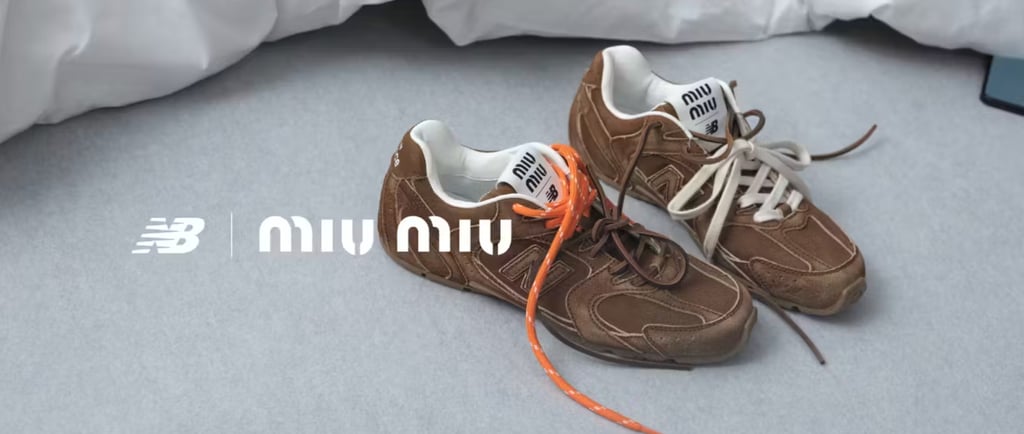
Miu Miu was born in 1993 as the rebellious little sister of Prada, created by Miuccia Prada as a space where her creativity could unfold with fewer constraints and more instinctive freedom. Named after her childhood nickname, the brand quickly distinguished itself from its older counterpart, embracing a more playful, irreverent, and experimental identity while still maintaining a deep intellectual foundation.
At the heart of Miu Miu lies a very personal inspiration. During her youth, Miuccia Prada was deeply influenced by the social and political upheavals of the late 1960s, particularly the student protests of 1968. In that charged atmosphere, she encountered a generation of young women who were challenging conventions, redefining what it meant to be feminine. These women were not polished or conventional; they were curious, rebellious, sometimes contradictory, and it is precisely this complexity that would later shape the spirit of Miu Miu.
This influence translated into a distinctive aesthetic language from the very beginning. Early collections featured suede jackets with fringes and patchwork skirts, evoking a sense of freedom and nonconformity. Over time, the brand developed a signature style that plays with contrasts: bourgeois silhouettes reimagined with a subversive twist, knee-length skirts paired with oversized or rounded shoulders, unexpected textures, and bold color palettes that shift from refined neutrals to striking neon accents. Prints often draw from nature, while proportions and styling subtly disrupt traditional elegance.
In this way, Miu Miu is more than just Prada’s diffusion line, it is its alter ego. A creative laboratory where memory, rebellion, and femininity intersect, allowing Miuccia Prada to continuously reinterpret the past while anticipating the future.
In December 2025, MiuMiu and New Balance were awarded “Collaboration of the Year,” which represents a defining moment in the convergence of luxury fashion and performance or activewear. The partnership thrives on a very powerful duality: Miu Miu’s identity rooted in Italian craftsmanship and trend-setting femininity, paired with New Balance’s technical expertise, market dominance and heritage in athletic footwear.
The balance in the 530 SL sneaker is evident in the refinement of a classic running style. By slimming the sole and elevating materials through Italian production, the design transforms a traditionally “everyday” sneaker into a coveted luxury object. The product therefore feels accessible and aspirational, which is an essential factor behind its rapid sell out and cultural relevance.
From a marketing perspective, the partnership illustrates a sophisticated level of insight regarding the contemporary female consumer. Both brands focus on the value of mobility to the female global audience, calling for an integrated sport and lifestyle offer. The growing popularity of “tennis core” looks and the shift in the consumer cyclical focus to sport luxe further validated the setting of the collab within the contemporary market.
The involvement of Coco Gauff adds another layer of strategic depth. As both a high-performing athlete and a Gen Z cultural figure, Gauff embodies the fusion of sport and style, reinforcing the collaboration’s authenticity while expanding its reach beyond traditional fashion audiences.
Ultimately, the success of New Balance x Miu Miu lies not only in its products but in its narrative. By combining heritage, scarcity, and cultural timing, the partnership moves beyond a simple collaboration, establishing itself as an ongoing dialogue between luxury and sport, and setting a benchmark for future cross-industry ventures.
Beyond Coco Gauff, the success of the Miu Miu x New Balance collaboration can be better understood by looking at how it gradually spread across different layers of influence rather than through a single campaign. After its initial appearance on the runway, the sneakers began to circulate within fashion week environments, where editors, stylists, and insiders were among the first to adopt them. This early visibility positioned the product as something desirable within a restricted, almost insider community.
From there, celebrities such as Joey King and Gigi Hadid contributed to a second phase of diffusion. By wearing the sneakers in off-duty contexts, often combining them with feminine or tailored pieces, they helped redefine the product not as purely athletic footwear but as part of a broader everyday wardrobe. This shift was important because it changed the perception of sneakers from a trend to a versatile object.
At the same time, digital creators on Instagram and TikTok played a more operational role in translating this visibility into concrete consumer behavior. Rather than simply showing the product, they demonstrated how to style it, how to integrate it into daily outfits, and how to personalize it. This type of content reduced the distance between luxury and everyday use, making the collaboration easier to understand and imitate. In parallel, discussions around availability, resale value, and restocks created a sense of urgency and scarcity, which reinforced demand beyond the initial launch moment.
What emerges from this process is not a traditional top-down influence, but a layered circulation of the product: from runway to insiders, from celebrities to social media creators, and finally to broader digital communities. Each group did not simply promote the collaboration, but transformed its meaning slightly, allowing it to move across contexts, from performance to fashion, from exclusivity to everyday wear. This dynamic helps explain why the Miu Miu x New Balance partnership maintained visibility and relevance over time, becoming less a one-time collaboration and more an ongoing cultural presence.