
Japanese avant-garde wave in 1980 Paris: how it came to be
FASHION
Federico Fattori
1/14/20262 min read
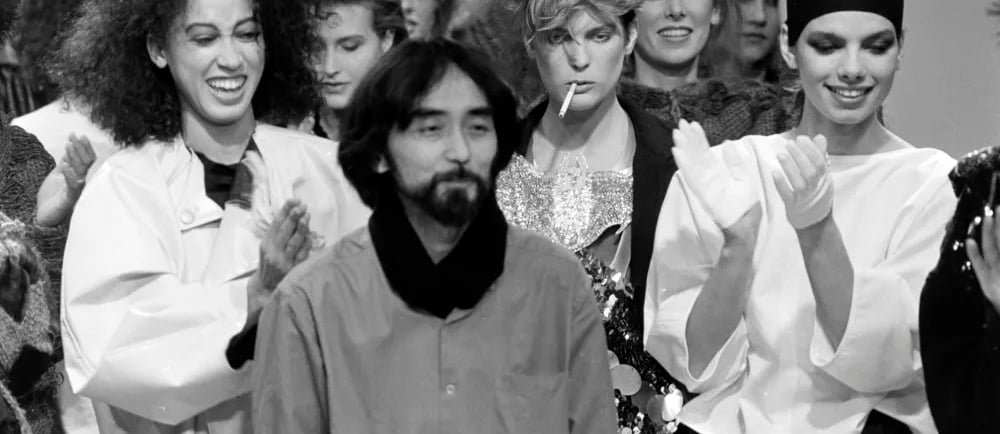
April 1981, Paris; Rei Kawakubo and Yohji Yamamoto present their first show in the French capital. A slow start, carefully planned, to finally achieve international recognition. Already famous in their homeland Japan, the two designers decided to follow in the steps of other Japanese designers who went to Paris for their breakthrough. Kenzo Takada, Hanae Mori, and Issey Miyake were all already established in the world capital of fashion, but while the former two leaned more towards the western style, the latter joined the Yamamoto-Kawakubo duo to form a trio that shaped fashion forever, reinventing shapes and spaces.
An eastern influence on the West can be traced back to Marco Polo in the 13th century, but it wasn’t until the mid 19th century, during the Meiji Era, that Japan opened up to international trade, and its goods started to flood the European market. Prints and decorative patterns especially stuck with the West, while in fashion the airy, relaxed silhouette of the kimono helped in putting the final nail in the coffin of the corset. A century later it happened again; in the late 20th century Japan completely reinvented the western vesture.
Even though they had predecessors, Miyake, Kawakubo and Yamamoto are those remembered as the ones that changed the rules of the game. Others like Kenzo and Hanae Mori played more into the French style, adapting their heritage to the western canons, it was the trio who changed them, creating something new, and shifting the collective taste. All three had established brands in their home country, but still felt the need for more, for international success and recognition, and what better place than Paris.
First of the three was Miyake, who after his official international debut in New York, went back to Japan to launch his personal brand, eventually founding his home in Paris, starting to show his collections there in 1973. His sculptural and flowing forms became an immortal symbol of an elegance able to transcend time. So much so that his modern architectural approach can almost also be defined as gender-free and size-free, predating by far any sort of such label we have today.
Rei Kawakubo and Yohji Yamamoto came later in a sort of joint venture, suggested and led by Yamamoto itself. Not an overnight success, the work of the designers was received poorly at first, seen as unpleasant and for those who “stand alone”. Against all odds they were able to turn it into a narrative of strength and independence, being slowly incorporated in women’s outfit with singular pieces, later attracting mass attention thanks to the quality textiles, workmanship and the practicality of their relaxed fits.
Yamamoto’s work is characterised by the heavy, almost exclusive, use of the color black, and stood out thanks to his way of deconstructing a garment, reinventing it through a disassembly and reassembly process. Kawakubo also made deconstruction her forte, along with the reimagination of the retailing space into a piece of artistry, mutating it into what we know it as today.
Accompanied by the fast rise of Japan as an economic force thanks to companies such as Toyota, Sony and Panasonic, the interest for the “Made in Japan” spiked. Along with the technological industry, the fashion world was helping to define what Japan was to Westerners, and more than forty years later, we can say that that fateful first show in Paris defined the West too. Collection after collection Miyake, Kawakubo and Yamamoto managed to change the very core essence of fashion, creating a new universality that will forever be relevant.