Authority or Momentum? A New Dynamic Inside the Watches Holy Trinity
WATCHES & JEWELLERY
Francesco Mantegazza
3/23/20263 min read


Legitimacy and Leadership in High Watchmaking
In high watchmaking, legitimacy is not scarce. Certain maisons secured it decades ago through history, technical achievement, and cultural authority. What is scarce, and increasingly contested, is direction. The question in 2025 is no longer who belongs at the summit of haute horlogerie, but who defines what that summit represents today. Within this context, a clear divergence has emerged. Patek Philippe continues to embody institutional authority through continuity and restraint. Vacheron Constantin, by contrast, is asserting narrative and creative leadership, not by rejecting tradition, but by actively reinterpreting it.
Patek Philippe and the Weight of Institutional Authority
Patek Philippe occupies a position in watchmaking that is functionally unassailable. Its influence on the technical and aesthetic language of haute horlogerie is foundational. Perpetual calendars, chronographs, case design archetypes, and even market behavior have been shaped by Patek’s output over the last century. Its authority does not depend on novelty or provocation. It rests on accumulated legitimacy reinforced by auction results, scholarly recognition, and an almost archival relationship with its own history. This posture naturally favors cautious evolution. Recent collections reflect refinement rather than disruption, calibration rather than exploration. Patek Philippe does not seek to redefine excellence; it safeguards an established definition. That role remains indispensable. Yet it also implies a form of strategic immobility. Institutional authority preserves standards, but it rarely initiates new conversations.
Vacheron Constantin’s 2025 Statement of Intent
Vacheron Constantin approached its 270th anniversary not as a retrospective exercise, but as a declaration of intent. The conceptual framework of La Quête was not positioned as a search for validation, but as a reaffirmation of ambition. This distinction matters. Anniversaries are inherently narrative tools; what differentiates Vacheron’s approach is how deliberately it used the occasion to articulate a forward-facing vision. The unveiling of highly complex timepieces such as Solaria, combined with an uncompromising emphasis on métiers d’art, constituted a clear statement. Vacheron Constantin is not optimizing for market visibility or immediate consensus. It is asserting that intellectual difficulty, aesthetic rigor, and expressive complexity remain central to the definition of high watchmaking, even when they resist simplification or scalability.
Historical Foundations and a Distinct Philosophy
This position is not opportunistic. It is deeply rooted in Vacheron Constantin’s historical identity. As the oldest continuously operating watch manufacture, the maison’s contributions have often been less theatrical than those of its peers, but no less consequential. Its history reflects endurance, formal experimentation, and a persistent refusal to separate mechanical innovation from artistic expression. Decorative arts at Vacheron Constantin have never functioned as secondary embellishments. Engraving, enameling, and miniature painting have consistently been treated as integral to horological excellence, not as optional ornamentation. This long-standing integration explains why the brand’s contemporary emphasis on holistic complexity feels coherent rather than performative.
Contemporary Relevance and Collector Fatigue
The timing of this assertion is significant. The broader market has reached a point of conceptual fatigue, not due to lack of demand, but due to an erosion of meaning. Incremental variations on steel sports watches continue to sell, yet they no longer advance the intellectual or cultural discourse of watchmaking. Against this backdrop, Vacheron Constantin’s focus on demanding complications, artisanal mastery, and unapologetic difficulty resonates with a segment of collectors seeking engagement rather than recognition. The appeal is not immediate legibility, but depth. Understanding is not assumed; it is earned. This is a deliberate narrowing of audience, and therefore a calculated risk. Leadership, in this context, is defined by exclusion as much as by inclusion.
Reframing the Holy Trinity
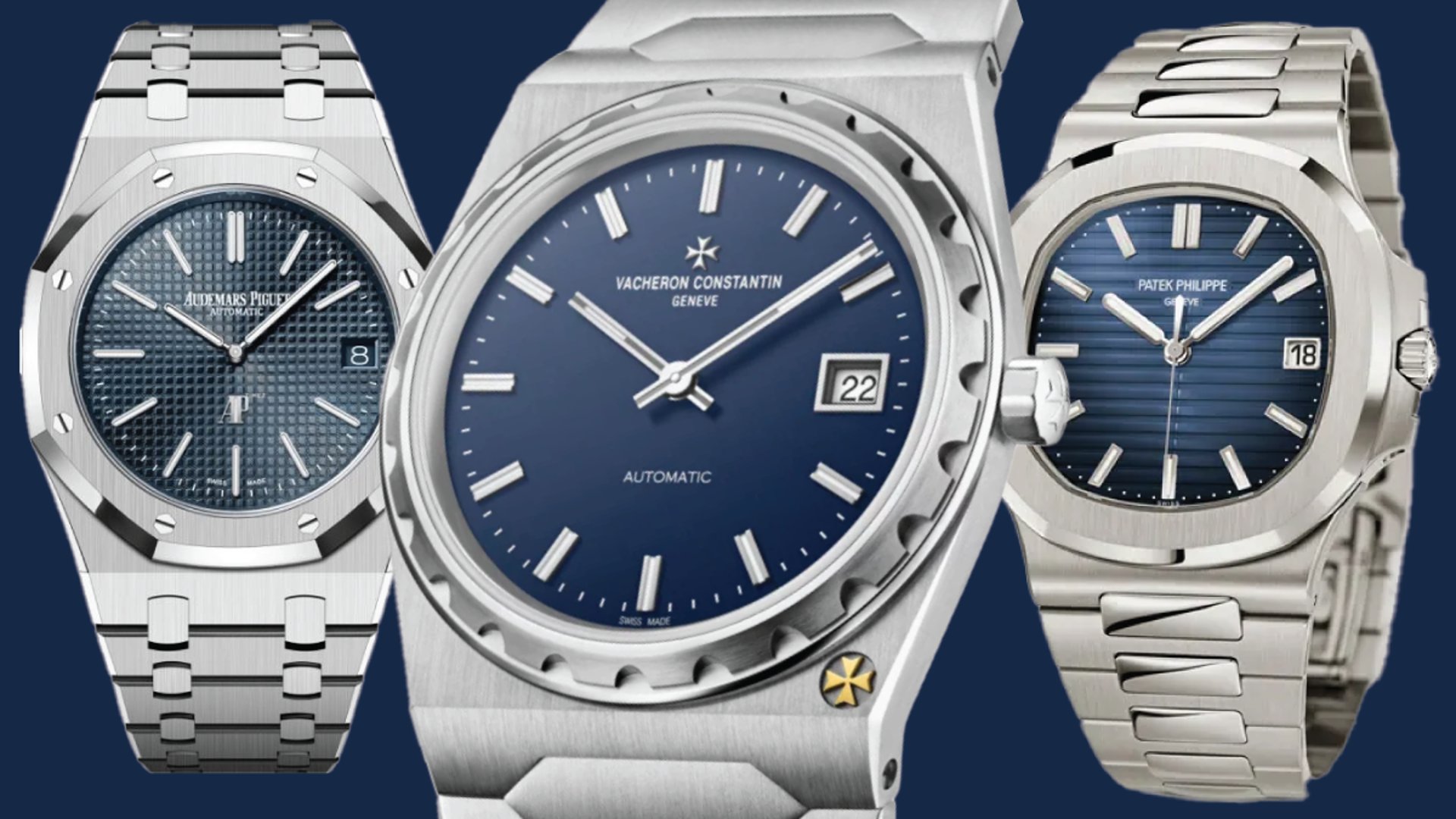
This strategy inevitably reframes the internal dynamics of the Holy Trinity. Audemars Piguet continues to lead through technical research, contemporary materials, and industrialized innovation, expanding the mechanical limits of serial production. Patek Philippe remains the institutional reference point, preserving continuity and authority. Vacheron Constantin, however, is repositioning itself as the maison most willing to challenge how excellence itself is articulated. Rather than competing on volume, visibility, or even technical extremity alone, Vacheron is contesting the criteria by which high watchmaking is evaluated. The emphasis shifts from recognition to interpretation, from preservation to ambition.
Direction Over Supremacy
This is not an attempt to supplant Patek Philippe, nor a claim of hierarchical superiority. It is a shift in narrative momentum. Leadership in haute horlogerie is not solely a function of invention or legacy. It is the capacity to define what matters at a given moment, and to do so with coherence and conviction. In 2025, Vacheron Constantin is asserting a vision of high watchmaking that is holistic, demanding, and resolutely expressive. It does not seek consensus. It seeks direction.
Conclusion
Whether this posture evolves into a sustained long-term strategy will become clear only with time. What is already evident is that Vacheron Constantin has moved beyond passive inclusion in the conversation. It is actively shaping its terms. In an industry rich in authority but increasingly cautious in ambition, that distinction is neither incidental nor trivial.